
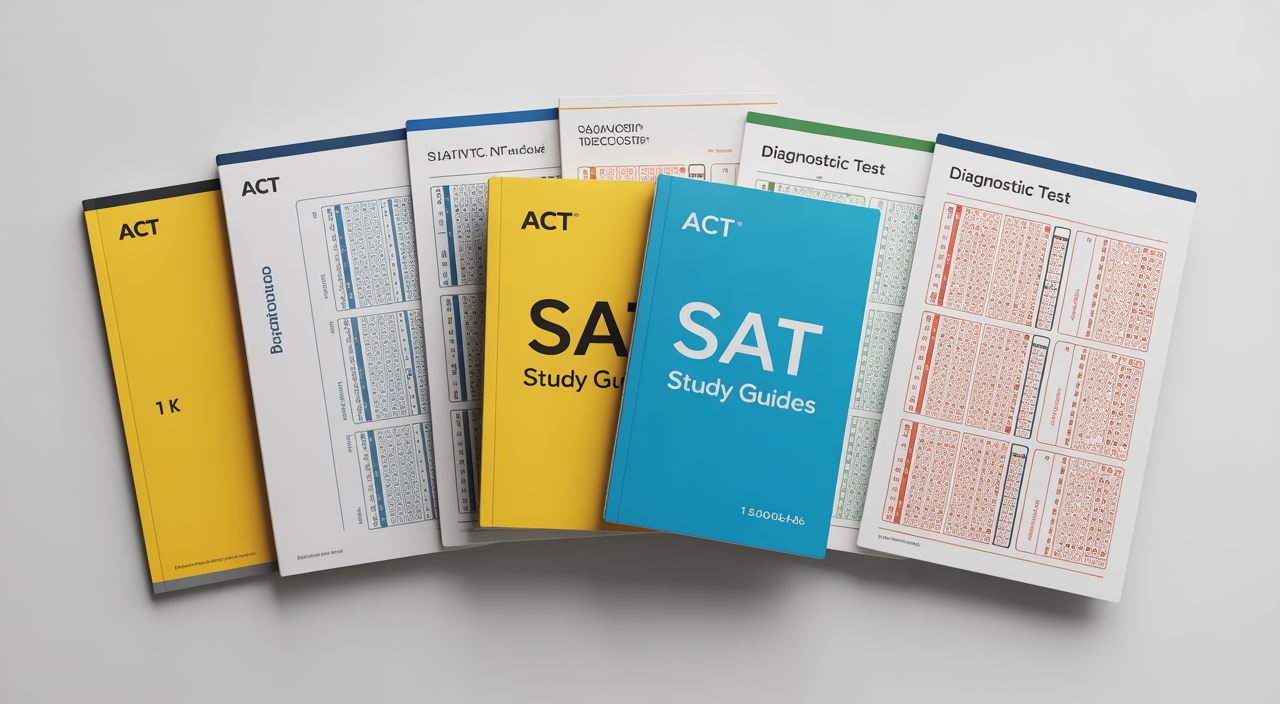
What makes the best ACT and SAT study guides for busy students?
Preparing for both exams at the same time can feel confusing. The formats are similar, but not the same. Time is limited, especially for Indian students balancing school, coaching, and entrance tests like JEE or NEET. That is why having smart, combined act and sat study guides saves effort and keeps you focused on what actually raises your score.
Instead of collecting random notes and videos, you can use one clear system. Think of it as a “dual prep plan” that covers both tests together. With a solid quick reference guide, you always know which topics to revise, what format to expect, and how to manage time in each section.
This article walks you through that system. You will see how the tests differ, get an 8‑week study plan, and learn section‑wise strategies that work well for Indian test takers aiming at global universities.
Why prepare for both ACT and SAT?
Both exams are standardized college admission tests used by many universities worldwide. Some colleges prefer one, but most accept either score. When you are applying from India, giving yourself both options can be a smart strategy.
Here is why a combined approach works well:
- More chances to shine: If one test day goes badly, the other score may still be strong.
- Score flexibility: You can send your best result to each college.
- Similar core skills: Reading, grammar, math, and reasoning overlap a lot, so prep time is shared.
If you enjoy structured, step‑by‑step learning, dual prep is practical. You can use one main guide, then fine‑tune for the test that feels more natural to you.
ACT vs SAT: Key differences you should know
Before choosing or combining tests, be clear on how they differ. A simple mental “comparison chart” helps:
- Timing style: The ACT is generally faster paced; the SAT gives slightly more time per question.
- Sections: The ACT has English, Math, Reading, and Science. The SAT focuses on Reading, Writing & Language, and Math, but also tests data and logic within passages.
- Math content: The SAT leans more on algebra and word problems. The ACT math covers a wider mix, including more geometry and a bit of trigonometry.
- Science section: Only the ACT has a separate Science section, which mainly tests data interpretation, graphs, and experiments, not deep science theory.
If you are strong in speed and comfortable with charts and experiments, the ACT may suit you. If you prefer a slightly slower pace and stronger focus on math reasoning and reading, the SAT often feels better.
How good ACT and SAT study guides help Indian students
A high‑quality combined guide saves you from starting from zero for each test. It should give you:
- A simple overview of test formats and scoring scales.
- Section‑wise strategies and timing plans.
- Practice questions that look and feel like real exam items.
- Checklists and weekly goals, so you do not waste time deciding what to study next.
As an Indian student, you may already be used to intense exam prep. A clear SAT and ACT quick reference simply channels that discipline towards the exact pattern of these international tests.
8‑week combined study plan for ACT and SAT
You can adjust this plan to fit your board exams, coaching classes, or other entrance tests. The idea is to touch both exams each week.
Weeks 1–2: Understand the tests and build basics
- Read through one good combined guide carefully.
- Take one short diagnostic test for each exam (not full length yet).
- Revise core math topics: fractions, algebra, linear equations, percentages, ratios.
- Start daily reading: international news, opinion pieces, and short science articles to grow vocabulary and comprehension.
Weeks 3–4: Strengthen core skills
- Work 3–4 sets per week of Reading and English/Writing questions.
- Do timed math practice, mixing SAT‑style and ACT‑style questions.
- Start light ACT Science practice to get used to graphs and experiments.
- Keep an error log: write down every mistake and why it happened.
Weeks 5–7: Full‑length tests and targeted drills
- Take one full SAT test and one full ACT test in this period, each on different weekends.
- Spend as much time reviewing the test as you spent taking it.
- Identify weak areas like “SAT algebra word problems” or “ACT Science timing” and drill them with 10–15 focused questions daily.
- Practice test‑day routines: bubbling answers, using breaks, and staying calm under time pressure.
Week 8: Final review and exam‑day strategy
- Do one more timed mixed‑section practice, not necessarily full length.
- Review your quick reference notes on formulas, grammar rules, and timing.
- Plan logistics: ID, admission ticket printouts, travel plan from India if needed, sleep schedule.
- Two days before the real test, focus on light revision and rest, not new difficult topics.
Section‑wise strategies that boost scores
SAT Math vs ACT Math
For SAT Math, word problems and algebra are very important. Practise converting long text into equations. Keep a small formula list and revise it daily.
For ACT Math, speed is the challenge. Do timed sets where you move quickly through easier questions and mark harder ones to revisit if time remains. Learn to use educated guessing instead of getting stuck.
Reading and Writing sections
- Read the questions first, then scan the passage with a purpose.
- Underline key lines or note paragraph numbers to avoid re‑reading everything.
- For grammar, focus on core rules: subject‑verb agreement, tense consistency, pronoun use, punctuation, and sentence structure.
ACT Science
This section is less about science facts and more about understanding charts and experiments. To improve:
- Skim the question first, then go straight to the relevant graph or table.
- Ignore extra theory; focus on numbers, trends, and relationships.
- Look for patterns such as “as X increases, Y decreases” to answer quickly.
Free practice resources and tools
You can combine a good quick reference sheet with free online practice to control your costs. Many students pair their main guide with structured resources, just as some families use detailed advice when they choose things like computer science classes for their kids.
Also, if you enjoy planning and organizing big goals in a simple way, you might like reading about how people structure major projects, such as making the most of the entire high school journey. The same mindset works beautifully for exam prep.
Use your chosen ACT and SAT study guides, then add:
- Official sample questions from exam websites.
- Free practice tests offered online.
- Printable worksheets for math topics you find tricky.
FAQs about ACT and SAT prep
Q1. Can I prepare for both ACT and SAT at the same time without burning out?
Yes, if you follow a clear plan and avoid overloading yourself with random materials. Use one combined guide, set fixed weekly hours, and focus on overlapping skills like reading and math first. Then, in the last few weeks, add targeted practice for ACT Science or specific SAT question types.
Q2. How do I decide which exam to finally focus on more?
After one or two full practice tests of each type, compare your scaled scores and comfort level. If your ACT score is clearly higher and you like fast pacing, lean more towards ACT. If you prefer the SAT style and your SAT score is stronger, give that exam extra attention while still keeping a backup ACT attempt if your schedule allows.
Q3. How early should Indian students start using ACT and SAT study guides?
Starting in Class 10 or early Class 11 works well, especially if you want time for retakes. Early prep does not need to be heavy; one or two hours a week of reading and basic math revision, guided by a quick reference plan, is enough at first. You can increase intensity in the 8–12 weeks before your chosen test dates.
With the right approach, combined ACT and SAT preparation feels structured, not stressful. A clear, easy‑to‑use guide keeps you confident, focused, and ready to present your best scores to universities around the world.

Mark Martin is a freelance writer and editor based in New York City. He has written extensively on topics ranging from technology, business and lifestyle. His work has been featured in major publications such as The New York Times, The Wall Street Journal and Wired Magazine.